
Why People with Dementia “Make Up” Events That Never Happened
Familiar dialogues?
— “Mom, what school? I’m 50 years old!” — “Dad, but you were home all day yesterday, what meeting?”
Such dialogues are familiar to many who care for people with dementia. Relatives are confused, irritated, trying to convince: “Don’t you remember? That didn’t happen!” But the person with the condition is certain of the opposite.
Why does this happen?
When memory collapses, the brain looks for ways to compensate for the gaps. Sometimes it retrieves old but real memories and substitutes them in place of lost ones (this is called pseudoreminiscences). And sometimes it completely makes up events that never happened (these are confabulations). The person is not lying, not manipulating – they sincerely believe in their version of reality.
Let’s examine in detail how this manifests, why it happens, and how to respond correctly.
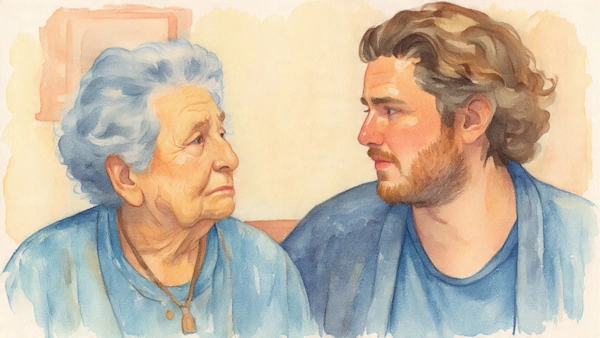
Image: re-cognition.center
What are pseudoreminiscences in people with dementia?
Pseudoreminiscences are the replacement of lost memories with real ones, but transferred from the past into the present.
📌 Example: Let’s say Margaret, 80 years old, lives in a nursing home. One evening she tells her daughter: — I need to go home, otherwise my husband will come back from work hungry.
In reality, her husband died 15 years ago, and she hasn’t lived at home for several years. But the brain substitutes an old, familiar picture of life, as if this moment from the past is happening right now.
📌 What does this look like?
- The person describes events that really happened, but confuses the time frames.
- They may consider themselves younger than they actually are.
- May expect meetings with people who are long gone.
These are not fantasies and not an attempt to deceive – this is the work of a damaged brain that retrieves available information, even if it’s outdated.
What are confabulations in dementia patients?
Confabulations are memories of events that never happened. They appear when a person has gaps in memory, and the brain automatically fills them with fabricated details.
📌 Example: Let’s say Robert, 78 years old, tells his caregiver: — I met with the governor yesterday, he presented me with an award.
In reality, he was home all day yesterday. But the brain doesn’t remember this and “draws” its own version.
📌 What does this look like?
- The person tells stories that never happened.
- They confidently give false facts, not understanding that they’re mistaken.
- Confabulations can concern any sphere: events, meetings, people.
It’s important to understand that the person sincerely believes their words. They’re not making things up intentionally – they simply cannot distinguish reality from fiction.

Image: re-cognition.center
Why does this happen?
Memory is a complex mechanism that works thanks to numerous neural connections in the brain. With dementia, these connections are destroyed, and the person loses access to information. But the brain doesn’t like voids. If it cannot restore real events, it either takes old ones (pseudoreminiscences) or fills the gaps itself (confabulations).
Several factors influence this:
- Destruction of neural connections;
- Decreased ability to analyze – the person stops critically evaluating their memory.
- Stress and anxiety – in stressful situations, the brain especially actively constructs memories.
How should relatives react?
❌ What NOT to do:
- Don’t argue and don’t try to convince. Phrases like “You’re confusing everything” or “That didn’t happen” only cause irritation and anxiety.
- Don’t laugh or mock. Even if the story seems absurd, it’s real for the person.
- Don’t ask questions that require precise memories. For example: “What year was that?” – this will only intensify the confusion.
✅ How to respond correctly:
- Calmly support the conversation. If grandma says she cooked soup yesterday (although she didn’t), you can reply: “Great, you always cooked so deliciously!”
- Soften anxious moments. If the person says their mother is waiting for them (who is no longer alive), don’t bluntly tell the truth. Better to say: “Mom cares for you, but she will come later”
- Redirect attention. If the story causes worry (for example, the person urgently wants to go home to children who are no longer there), you can smoothly change the topic: “Do you remember how you baked cookies as a child?”
Impact of pseudoreminiscences and confabulations on family life
When a person with dementia confuses memories, it not only causes anxiety for them, but also strongly affects their loved ones.
What emotions do relatives experience?
- Confusion – why is mom convinced I’m little, when I’m 50?
- Anger and irritation – how many times can I explain that grandpa died long ago?
- Guilt – maybe I’m not trying hard enough, since he’s so confused?
❗ It’s important to understand: this is not the fault of caregivers. The disease changes how the brain works, and this cannot be controlled. Accepting the situation is the first step toward reducing stress in the family.
How to distinguish pseudoreminiscences and confabulations from ordinary forgetfulness?
Some of you might start worrying: “What if I have dementia too? I also sometimes confuse things.” Here are the key differences:
Ordinary forgetfulness:
- We forget where we left our keys, but find them later.
- We remember an event after a hint.
- We also sometimes confuse dates and days of the week.
Pathological memory disorders:
- The person is certain that the neighbor hid the keys and robbed them.
- No reminders help, information simply disappears.
- The person believes they’re living in a different decade.
If memory problems have become systematic and cause anxiety, it’s better to see a doctor.
When to see a doctor
Some people confuse such symptoms with “just old age” and don’t seek help. But it’s important to understand: if a person develops frequent pseudoreminiscences or confabulations, this may be a sign of a serious disease.
❗ You should see a doctor if:
- The person confuses not only recent events, but also memories of important life moments.
- Doesn’t realize they’re mistaken.
- Often displays anxiety, irritability, restlessness.
- Makes up stories that become increasingly convoluted.
The earlier diagnosis begins, the greater the chances of slowing the development of dementia.
Pseudoreminiscences and confabulations are not conscious lies, but a manifestation of the disease. A person with dementia is not trying to mislead you – their brain simply works differently. The main thing is to remember that arguments and attempts to prove the truth are useless. It’s important to remain calm, support the conversation, help the person feel safe. If a loved one has started frequently confusing memories, don’t panic. Just back them up and guide them so that life remains comfortable – even if it’s no longer the same as before.
Take care of yourself and be healthy.
Sources & References
- Kopelman, M. D. (1987). “Two types of confabulation.” Journal of Neurology, Neurosurgery, and Psychiatry, 50(11), 1482-1487. (Distinguishes spontaneous vs. provoked confabulation)
- Gilboa, A., et al. (2006). “Mechanisms of spontaneous confabulations: a strategic retrieval account.” Brain, 129(10), 2610-2620. (Neural basis and temporal context confusion)
- American Psychiatric Association. (2013). DSM-5: Diagnostic and Statistical Manual of Mental Disorders (5th ed.). (Memory impairment criteria in major neurocognitive disorder)
Discussion 1
Of course, this is not the fault of the sick. But maybe it’s the fault of the caregivers?
Try nodding along for years, and your brains will go off the rails.
Join the Conversation
Your email address will not be published.